






logo

Why Does Face Swap Break When You Turn Your Head?

The Biggest Unsolved Problem in Deepfake Technology

We tested 10+ face swap tools and reviewed 25+ research papers to find out why every face swap looks perfect from the front — but falls apart the moment someone turns their head. Here's what we found, and how to fix it.

25+ Papers Reviewed

10+ Tools Tested

80% Fail on Side Profiles

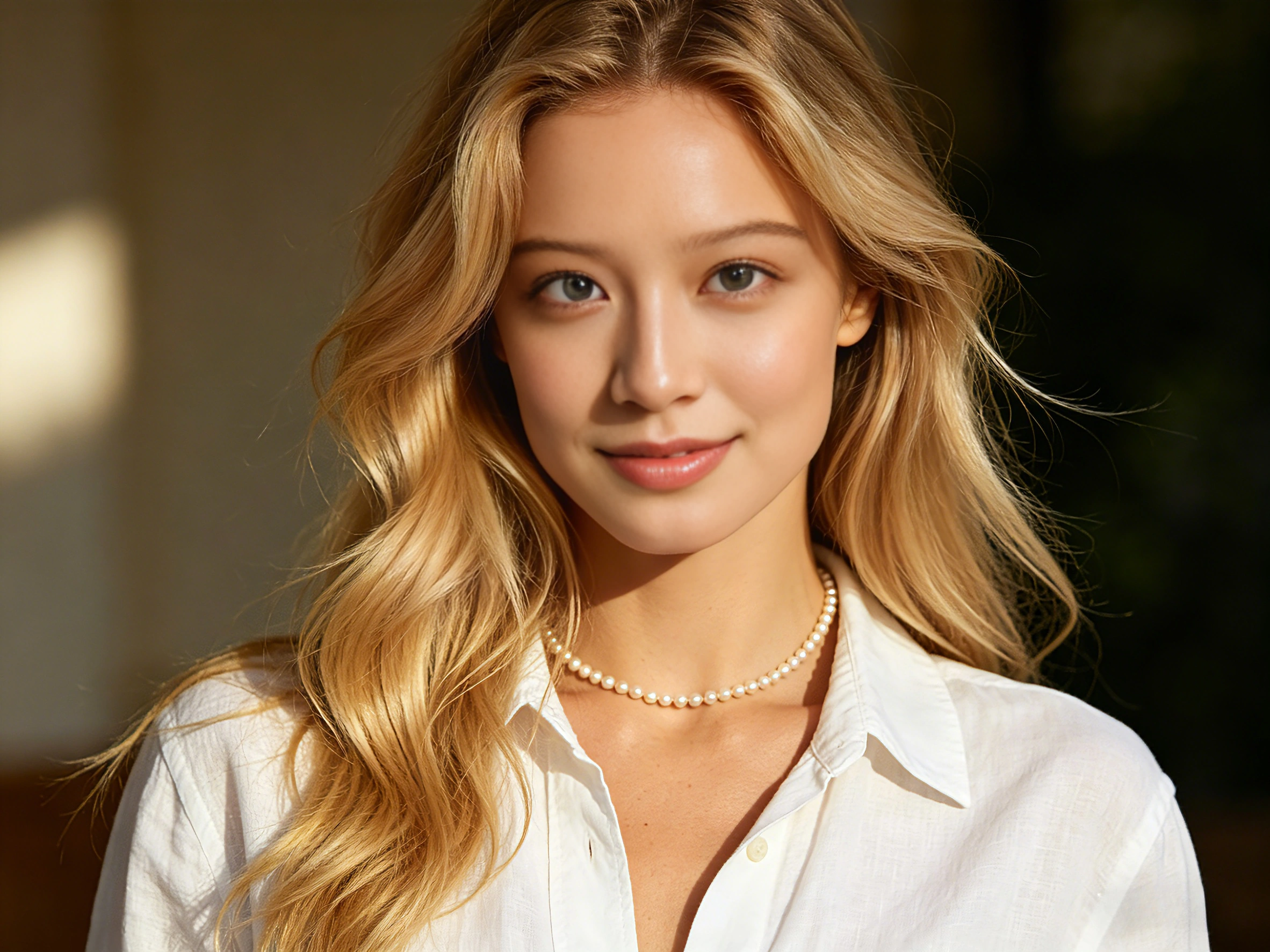
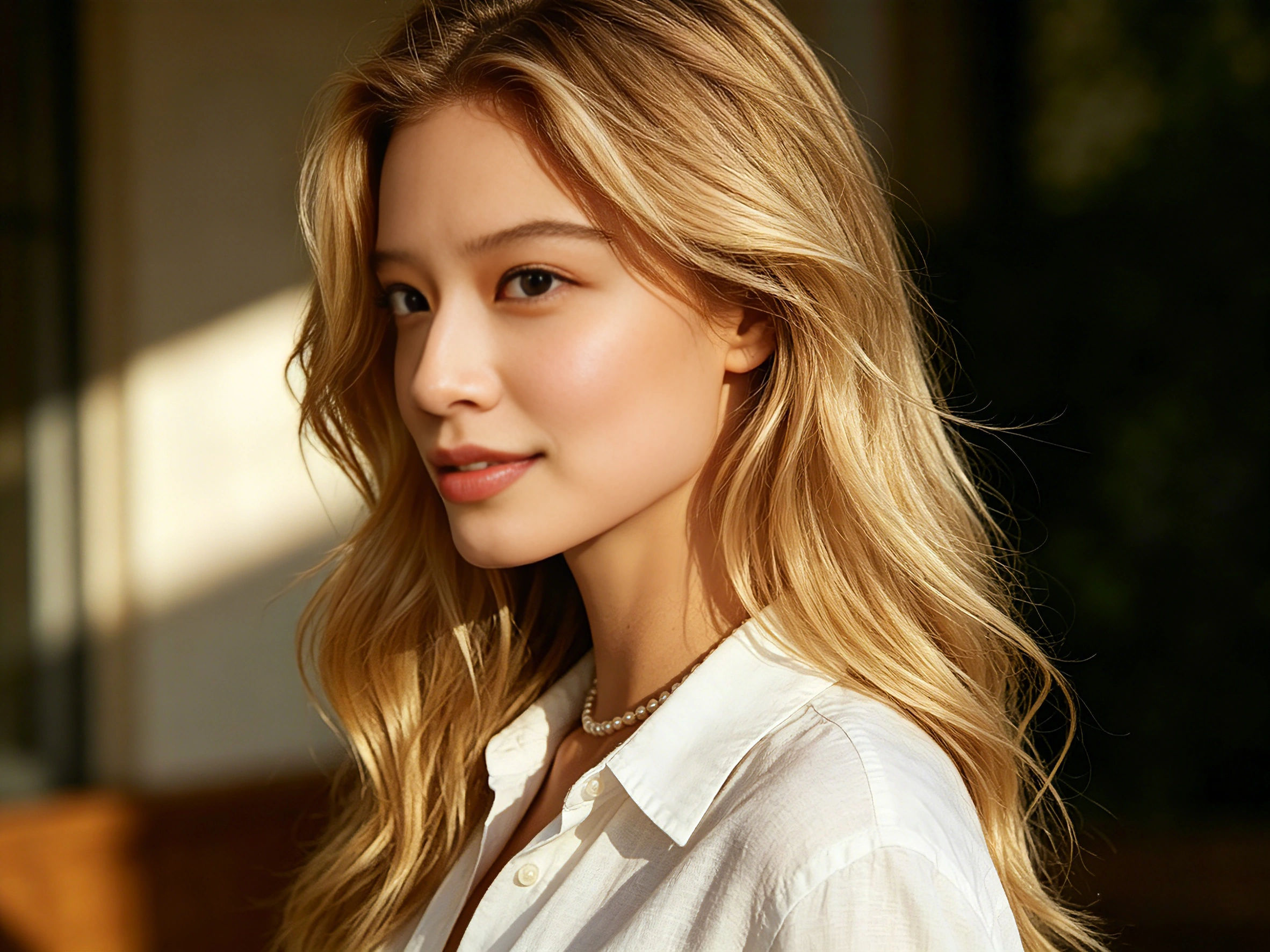
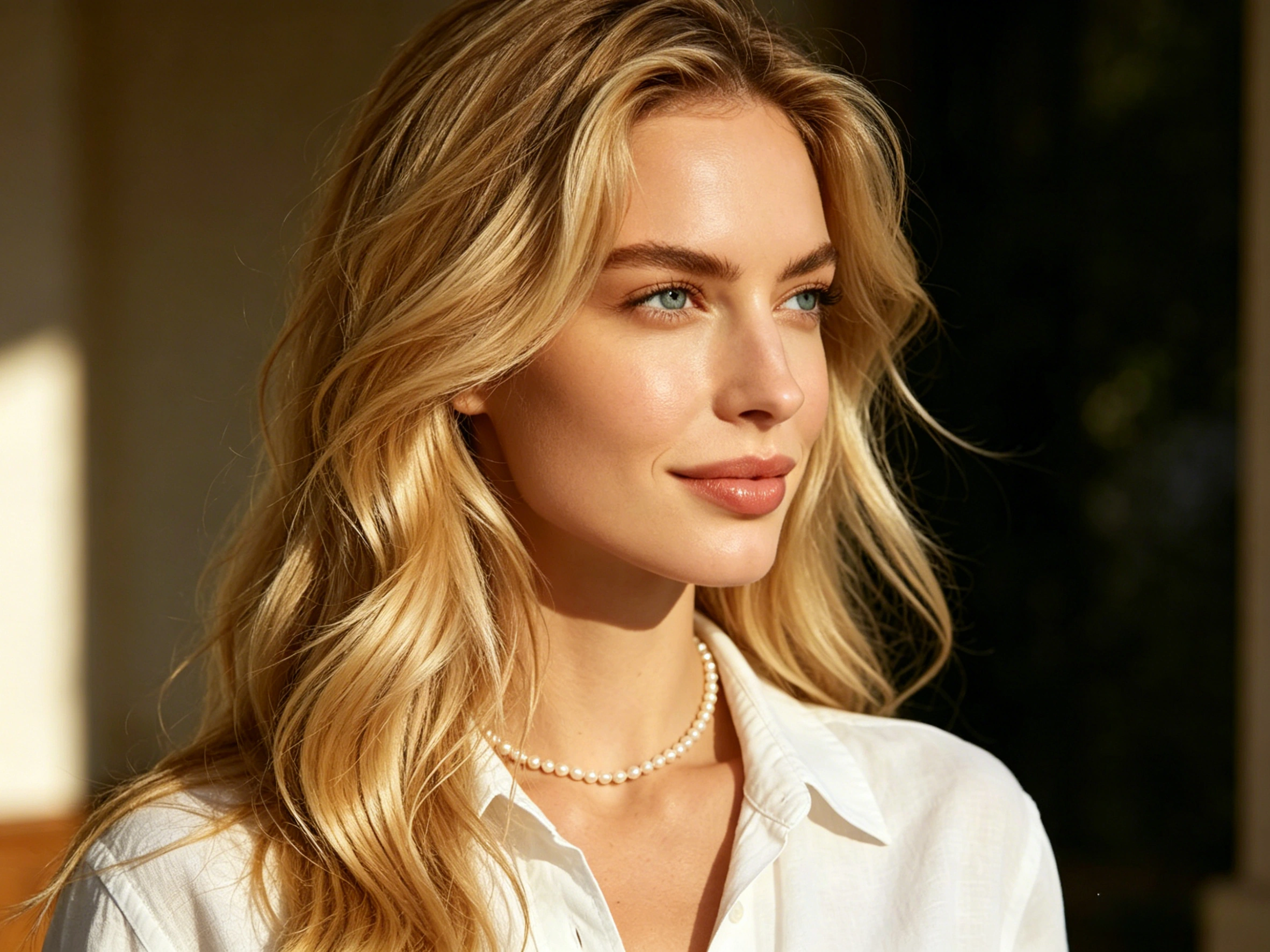
Face swap quality comparison: front view vs. side profile
Front After
Front Before
Front Before
Front After
Side After
Side Before
Side Before
Side After

TL;DR — The 3 Reasons Face Swap Fails on Side Profiles

1

Reason 1: The AI was only trained on front-facing photos. The face recognition models that power every major face swap tool (called ArcFace and InsightFace) were trained on datasets where over 95% of images show people looking straight at the camera. When the face turns sideways, the AI literally doesn't know what it's looking at.

2

Reason 2: The output resolution is painfully small. The most widely used face swap engine (inswapper_128) outputs faces at just 128×128 pixels — that's only 16,384 pixels total. For reference, a single emoji on your phone has more detail. Everything gets blurry and fake-looking when this tiny face is stretched to fit a high-resolution video.

3

Reason 3: The 3D face model breaks down. Face swap tools use simplified 3D face models to map one face onto another. These models need to see specific points on your face (like the corners of your eyes and the edges of your jaw). When you turn past about 60°, too many of these points vanish, and the entire process collapses.

How Face Swap Quality Drops as the Head Turns

The further the face turns from center, the worse the result gets. Here's exactly what happens at each angle.

Perfect conditions. Both eyes visible, full symmetry, all facial features clear. Face swap works at its best here. Accuracy: ~89.7%.

Face swap result at 0° (front view)
15°

The first signs of trouble appear. Measurable performance degradation begins. Most users won't notice issues yet, but the AI's confidence is already dropping.

Face swap result at 15° angle
30°

Now you can see it. Accuracy drops 10–15 percentage points. The far eye starts losing detail, jaw asymmetry appears, and subtle "uncanny valley" effects creep in. This is where most casual face swaps start to look off.

Face swap result at 30° angle
45°

Significant quality loss. The AI struggles to maintain identity. You might notice the swapped face looks subtly like a different person. The far eye may appear misshapen, and the jawline doesn't quite match.

Face swap result at 45° angle
60°

Critical failure zone. Key facial landmarks (eye corners, jaw symmetry points) start disappearing entirely. The 3D face model can no longer reliably map the geometry. Results look obviously fake or like a completely different person.

Face swap result at 60° angle
90°

Complete breakdown. Only one eye visible (or none), half the face hidden. The AI has almost no information to work with. Face swap either fails entirely, produces grotesque artifacts, or outputs a face that bears zero resemblance to the source.

Face swap result at 90° (full side profile)

In concrete numbers: ArcFace recognition accuracy drops from 89.7% (front) to around 80.4% (moderate side angle) — a nearly 10% drop. In uncontrolled conditions (bad lighting, motion blur), accuracy can plummet over 30 percentage points.

Think of it this way: trying to face-swap a side profile is like trying to recognize your friend from a photo where half their face is cut off. You might guess who it is, but you're not sure — and that's exactly how the AI feels.

The 3 Root Causes — Explained Simply

Understanding why face swap fails is the first step to fixing it. Here are the three fundamental problems, broken down for everyone.

Every face swap tool relies on a face recognition AI called ArcFace (part of a family called InsightFace). This AI's job is to look at a face and create a mathematical "fingerprint" of it — a list of numbers that captures what makes your face uniquely yours.

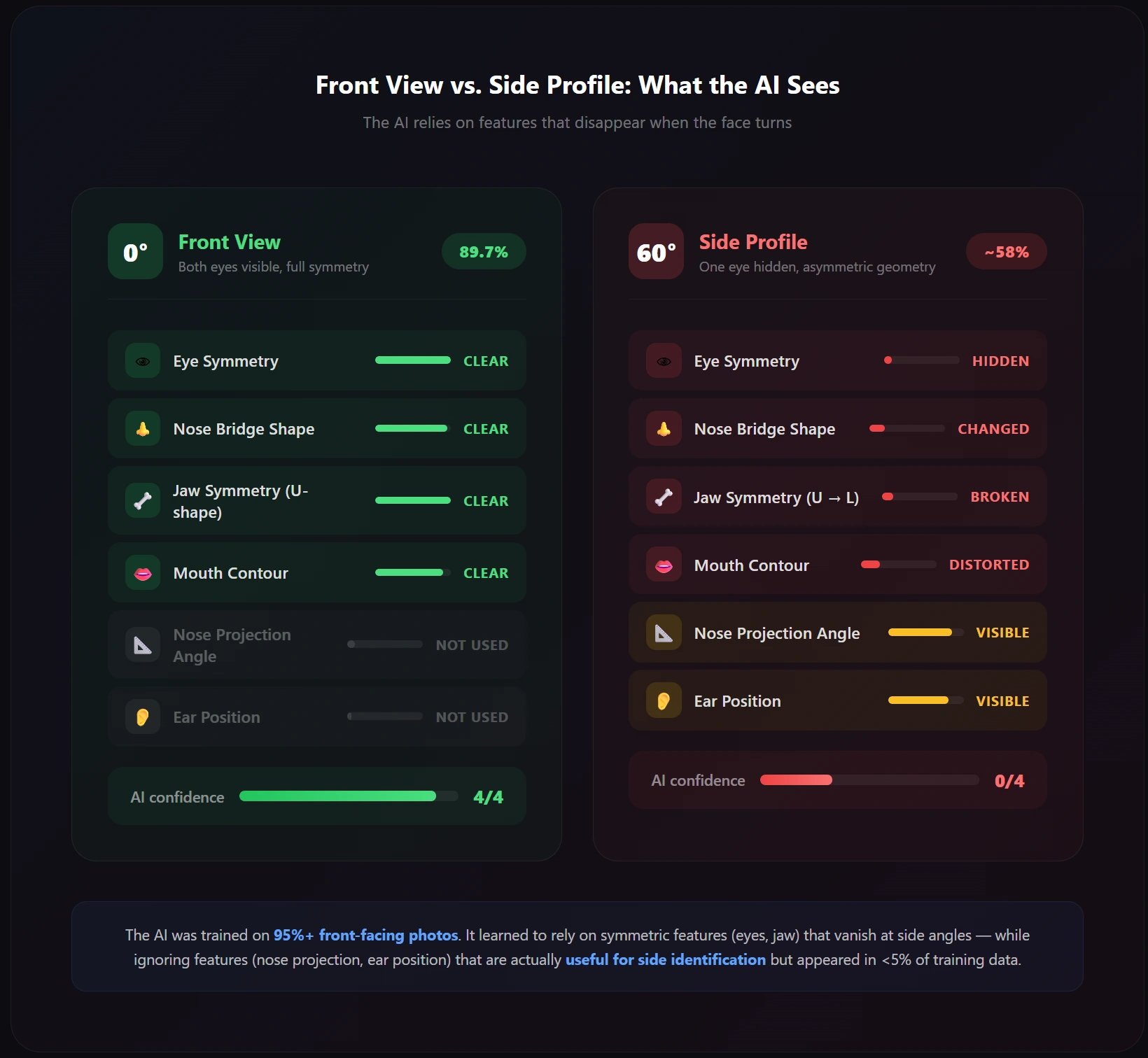
The problem? ArcFace was trained on millions of face photos, but over 95% of those photos are front-facing shots. Think of it like teaching someone to recognize dogs, but only ever showing them photos of golden retrievers. When they see a poodle, they're confused.

When you look straight at the camera, the AI can rely on symmetry: two eyes evenly spaced, nose centered, jawline balanced on both sides. These are powerful features for identification. But when you turn your head, all of that disappears:

  • The symmetric eyes you rely on? One is now hidden or distorted.

  • The nose bridge viewed from the front? It's now a profile silhouette — a completely different shape.

  • The jawline? It goes from a U-shape to an L-shape.

Meanwhile, features that are actually useful for identifying side profiles — like the nose projection angle, cheekbone depth, and ear position — were barely learned by the AI because they appeared in less than 5% of its training data.

The result: when you try to face-swap in a video where someone turns their head, the AI's "fingerprint" of their identity becomes unreliable. The swapped face starts drifting — it might flicker between frames, or gradually morph into someone who looks nothing like the source face.

30%+ drop in facial embedding quality at side angles
Diagram: front vs. side face feature comparison

Face Swap Tool Comparison: How They Handle Side Profiles

We compared the most popular face swap tools specifically on their ability to handle head rotations. The results are sobering: 8 out of 10 tools completely failed when faces turned past 60°.

Deepfacelab

~70°

Core Strength

Multi-image training, highest possible quality with enough data

Core Weakness

Requires hundreds of training images + hours of GPU training time

Best For: Professional projects

Visomaster

~45–50°

Core Strength

One-click install, TensorRT acceleration, real-time preview

Core Weakness

Still limited by the inswapper engine underneath

Best For: Content creators

Facefusion

~45°

Core Strength

Clean interface, open source, straightforward

Core Weakness

Complex config, hungry for GPU VRAM

Best For: Developers & technical users

Ropenext

~45°

Core Strength

Powerful masking features, head-editing mode

Core Weakness

No drag-and-drop, intimidating UI for beginners

Best For: Advanced users

Reactor

~35–40°

Core Strength

Integrates into ComfyUI pipelines, composable with other nodes

Core Weakness

"Pasted on" look, poor occlusion handling

Best For: ComfyUI workflow users

Liveportrait

Any angle

Core Strength

No identity leakage, stable at all angles

Core Weakness

Not face swap — it's face reenactment (drives expression, doesn't change identity)

Best For: Anonymization & animation

Key finding: all mainstream 2D face swap tools have hit a fundamental mathematical limit when it comes to extreme pose changes. The next generation of 3D-aware methods is the only path to a real solution.

After
Before
Before
After

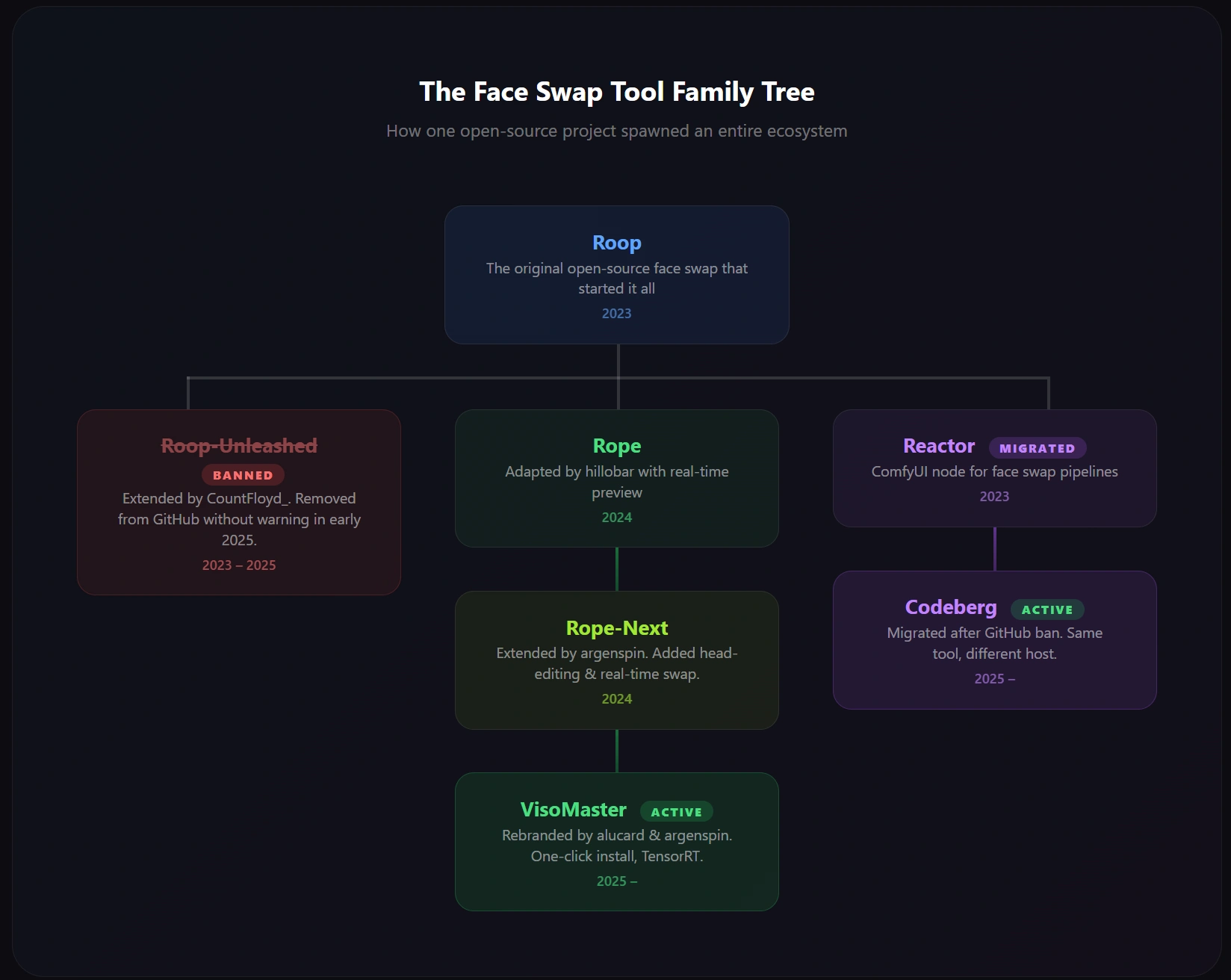
The Face Swap Tool Family Tree

The world of face swap tools has a surprisingly dramatic history — including sudden bans, platform migrations, and rapid forks. Understanding this helps you find the right tool today.

The Origin: Roop

It all started with Roop, an open-source face swap tool that made the technology accessible to everyone. From Roop, the ecosystem branched into multiple directions.

Roop-Unleashed

BANNED

An extended version by developer CountFloyd_ that became the community's go-to face swap app — until GitHub banned it without warning in early 2025.

Rope → Rope-Next → VisoMaster

A parallel branch adapted by hillobar into Rope, then extended by argenspin into Rope-Next (adding head-editing and real-time swap), and finally rebranded as VisoMaster by alucard & argenspin.

Reactor (ComfyUI)

A ComfyUI node for face swap that integrates into larger AI image generation pipelines. After GitHub's crackdown, it migrated to Codeberg.

The GitHub Ban

In early 2025, GitHub (owned by Microsoft) removed Roop-Unleashed and Reactor without any prior warning — no DMCA notice, no copyright claim, no explanation. The developer stated:

Since I believe I haven't done anything wrong, I don't feel I should have to jump through hoops to reinstate a project that was taken down without justification.

— CountFloyd_

Community analysis pointed to Microsoft's extreme risk aversion around face-swap technology, especially as multiple countries began classifying non-consensual deepfakes as serious crimes. The tools themselves weren't illegal, but GitHub didn't want to be seen as hosting them.

The community migrated to Codeberg (a European open-source platform) and continues development there. Installing from Codeberg works identically to GitHub — it's just a different git URL.

Visual family tree of face swap tools showing the evolution from Roop

How to Fix Face Swap on Side Profiles

No tool can perfectly solve the side profile problem yet — but these proven workflows come closest. Each approach has different trade-offs in quality, speed, and difficulty.

IP-Adapter FaceID + LoRA + ControlNet (ComfyUI)

Most Reliable for Angles

This is currently the most reliable way to maintain face consistency across different angles. Instead of doing a post-process face swap, this approach influences the AI image generation itself so the face is baked into the image from the start.

It works in three layers, each doing a different job:

Layer 1: IP-Adapter FaceID

This feeds the face's features directly into the image generation model. Set the weight to 0.7–0.85 (too high makes the image rigid; too low loses the likeness). Start/End range: 0.0–0.1 to 0.8–0.9. Use the FaceID Plus V2 preset for best results.

Layer 2: Character LoRA

A small fine-tuned model that captures the person's overall look — body type, clothing style, hair. Set strength to about 0.6. For long-term characters (500+ images/month), it's worth training a dedicated LoRA.

Layer 3: ControlNet Pose

Controls the body pose and head angle of the generated image, ensuring the output matches the desired composition.

Critical Tip

Your reference images should include multiple angles — front, side, and three-quarter views. If you only feed front-facing photos, the model will struggle with side angles just like the basic face swap tools do.

ComfyUI node graph showing IP-Adapter + LoRA + ControlNet workflow

The Cutting Edge: Research That's About to Change Everything

Researchers are actively solving the side profile problem. These four approaches represent the bleeding edge — and some may become available as practical tools within the next year.

AlphaFace (2026)

Real-Time + Best Angles

AlphaFace throws out the old approach of trying to build better 3D face models. Instead, it uses a Vision-Language Model (VLM) and CLIP — the same technology behind AI image generation — to understand faces at a conceptual level rather than a geometric one.

What this means in plain language: instead of trying to measure the exact position of your nose in 3D space, AlphaFace understands that "this is a woman with high cheekbones, a narrow nose, and arched eyebrows" — and that description stays the same whether you're facing the camera or turned sideways.

41.5 FPS real-time speed — fastest in its class. Pose error 17.4% better than the previous best (FaceDancer) on extreme angle datasets.

The clever trick: CLIP is only used during training. At runtime, the model runs without it, keeping inference fast enough for real-time video.

DiffSwap++ (2025)

Best Identity Preservation

DiffSwap++ integrates 3D face information into a diffusion model (the same type of AI that powers Stable Diffusion and DALL-E). During training, it learns to use 3D facial structure to guide the image generation process.

The result: 95.1% identity retrieval accuracy on the FFHQ dataset — meaning if you swap a face and then run face recognition on the result, it correctly identifies the source person 95% of the time. That's dramatically better than older methods like SimSwap (77.8%).

95.1% identity retrieval rate. Best FID score (6.57) = most realistic-looking results in benchmarks.

The trade-off: diffusion models are slow. Each frame takes seconds, not milliseconds. This makes DiffSwap++ impractical for real-time video but ideal for high-quality single images or offline video processing.

DynamicFace (2025)

Best for Video

DynamicFace specifically targets the video consistency problem — the flickering and identity drifting that happens when face swap processes each frame independently. It separates face information into four layers: background, surface normals (3D shape), facial landmarks, and UV texture.

By processing these layers separately and adding temporal attention (the AI looks at nearby frames, not just the current one), DynamicFace produces face swaps that stay consistent as the head moves. No more identity flickering between frames.

First method to combine fine-grained face decomposition with Stable Diffusion + AnimateDiff for temporally consistent video face swap.

articles.why-face-swap-fails.academic_dynamicface_p3

3D Gaussian Splatting (2025)

Full 3D Scene

This approach takes a radically different path: instead of processing 2D video frames, it builds a complete 3D scene using a technique called Gaussian Splatting (a faster alternative to NeRF). The face swap happens in full 3D space, then the result is rendered from any desired angle.

This completely sidesteps the angle problem because the face exists as a 3D object. It can be viewed from any direction without quality loss. It also naturally resists depth-based deepfake detection methods.

True 3D face swap — works at any angle by definition. Built on FLAME + 3DGS for real-time rendering.

The limitation: it currently needs multi-view input data, making it less practical for casual use. But as 3D reconstruction from single images improves, this approach could eventually become the default.

How to Spot a Failed Face Swap: Artifacts & Tell-Tale Signs

Whether you're checking your own work or learning to identify deepfakes, here are the specific visual clues that reveal a face swap — especially at side angles.

Spatial Artifacts (What You See in a Single Frame)

Temporal Artifacts (What You See Across Video Frames)

Current automatic detection systems reach about 80–85% accuracy on high-quality deepfakes — better than humans (around 50%), but far from perfect. The best detection methods now use temporal analysis (looking at sequences of frames) rather than analyzing single images.

What the Community Is Saying

Real experiences from face swap users on Reddit, GitHub, and forums. These aren't theoretical complaints — they're people hitting the same walls you are.

We had the same problem with face orientation and embeddings, that's why we decided to apply FaceID only when people were facing the camera.

u/Drivit_K

An engineering team that built a face recognition system and found that side profiles were so unreliable they had to filter them out entirely — only processing front-facing frames.

Facing the exact same issue, using InsightFace's ArcFace (buffalo_l), were you able to find a solution for this? My use case involves around CCTV feed fetched at 5-7fps and side faces most of time gets matched to the wrong embedding.

u/katashi_HVS

Posted in May 2026 — showing this problem remains unsolved even in commercial applications. The combination of low frame rate and side angles makes recognition nearly impossible.

Sometimes deepfakes start resembling the original actor from certain poses. It can also happen if the face tracking fails.

u/_half_real_

Describing the "identity leak" problem where the original person's face starts showing through the swap during head turns.

Any faceswap higher than 128x128 I can use or license? Tried to contact InsightFace AI already for a year but they never reply.

@levelsio

Well-known indie developer publicly frustrated that the 512px model exists but InsightFace refuses to respond to licensing requests — even after a full year of trying.

Trying to do this subtly so no one notices (they will) is not a viable strategy. If you don't want your face shown, consider being a V-tuber or using a 3D model replacement.

u/aMac_UK

Blunt reality check for a user wanting to use face swap for YouTube anonymity. The community consensus: current technology simply cannot produce undetectable real-time video face swap.

Reactor is quite literal and can look pasted on and not blended enough with the underlying style.

r/StableDiffusion user

A common complaint about Reactor that led to the hybrid workflow (combining Reactor with IP-Adapter) described in our solutions section.

Community Consensus

The unanimous view across Reddit (r/StableDiffusion, r/computervision, r/MediaSynthesis): side profile face swap is the #1 unsolved problem. No current tool handles it well. The community quality ranking is: DeepFaceLab > LoRA/Dreambooth > Roop/Reactor/FaceFusion.

Which Solution Should You Use?

The best approach depends on your specific needs. Use this quick guide to find your path.

Quick face swap, angles under 30°

FaceFusion or VisoMaster

Good

Need side profiles, willing to invest training time

DeepFaceLab (multi-angle training data)

Very Good

Character consistency across many angles

IP-Adapter FaceID + LoRA (ComfyUI)

Good to Very Good

Anonymization (don't need to change identity)

LivePortrait

Excellent

Maximum quality, speed doesn't matter

DiffSwap++ or DynamicFace (academic tools)

Best Available

Real-time + large angles (future)

AlphaFace (wait for open-source release)

Best (Coming Soon)

What's Coming Next: The Future of Face Swap Technology

The side profile problem won't be unsolved forever. Here are the five trends that will reshape face swap technology in the coming years.

1

Semantic Understanding Replaces Geometry

Instead of trying to measure faces in 3D space (which fails at extreme angles), next-gen models will understand faces through language and concepts. AlphaFace's VLM+CLIP approach is the pioneer here — describing "who" someone is rather than "where" their nose is. This makes identity robust to any angle.

2

3D Gaussian Splatting Replaces NeRF

Gaussian Splatting renders 3D scenes dramatically faster than NeRF (Neural Radiance Fields). This means full-3D face swap — where the face is a 3D object that can be viewed from any angle — will become practical for real-time use.

3

Diffusion Models Go 3D-Aware

The same AI architecture behind Stable Diffusion and DALL-E will be extended to understand 3D structure natively. DiffSwap++ is an early example. Future models will generate face swaps that are geometrically correct by construction, not as a post-process fix.

4

On-Device Real-Time Processing

InsightFace's 512-live model already runs at 30+ FPS on an iPhone. As mobile chips get more powerful and models get more efficient, high-quality face swap will run locally on your phone without needing a cloud GPU.

5

Temporal Consistency Becomes Standard

The frame-by-frame flickering problem will be solved by temporal attention modules — AI components that look at sequences of frames instead of individual images. DynamicFace's AnimateDiff integration shows the direction. Expect this to move from academic papers into everyday tools within 1–2 years.

Frequently Asked Questions

Ready to Try Face Swap Yourself?

Now that you understand the limitations and solutions, try our face swap tool — optimized for the best possible results within current technology.