Deepfake Media Literacy Lesson Plan: Free 40-Minute Lessons, Worksheet & Anchor Chart
Twenty-five US states have now passed media literacy legislation, and four of them (New Jersey, Delaware, Texas, and California) require it across all K-12 grades (Media Literacy Now, 2026 U.S. Media Literacy Policy & Impact Report). Tennessee’s new Teen Social Media and Internet Safety Act goes further and explicitly requires grades 6-12 to learn how to evaluate AI-generated content. But the same report flags a gap every teacher already knows: legislation is outrunning implementation. Teacher training, curriculum guidance, and funding haven’t caught up.
In other words: the law says teach deepfakes. Nobody handed teachers the lesson.
That’s what this page is for. Below you can download a complete, classroom-ready resource set: two 40-minute lesson plans with minute-by-minute timing (grades 6-8 and 9-12), a two-sided student worksheet, and a printable anchor chart. No sign-up, no email required. Every detection technique is updated for the current generation of AI video models.
Download the Free Resources
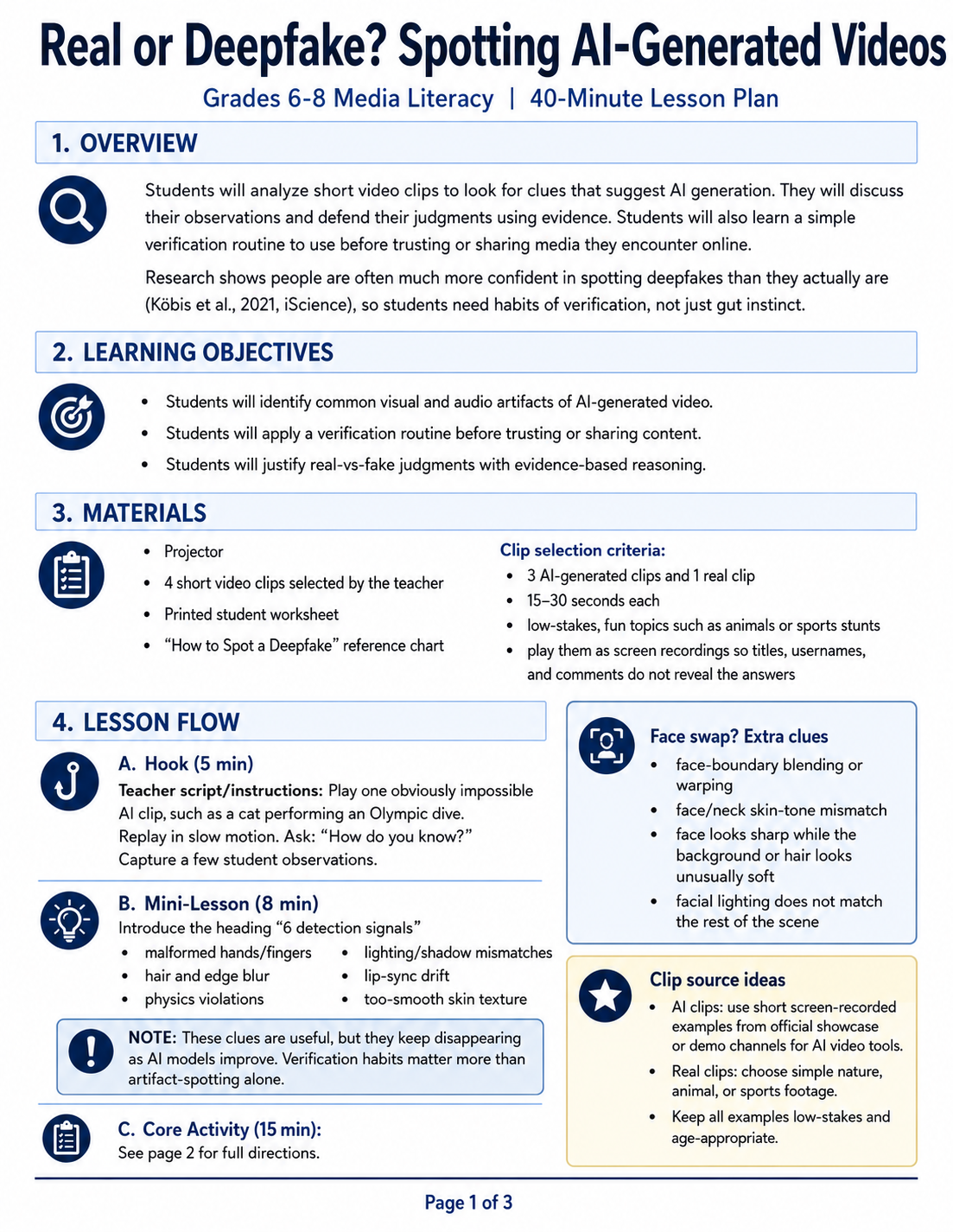
Lesson Plan A — "Real or Deepfake? Spotting AI-Generated Videos"
PDF · 3 pages · Grades 6-8 · 40 minutes
A complete 40-minute lesson: hook (an impossible AI clip in slow motion), mini-lesson on 6 detection signals, the "3 Fakes, 1 Real" judgment game with a four-corners debate, the 3-step verification habit, and an exit ticket. Includes a where-to-find-clips guide, sentence stems, differentiation, and a standards table.
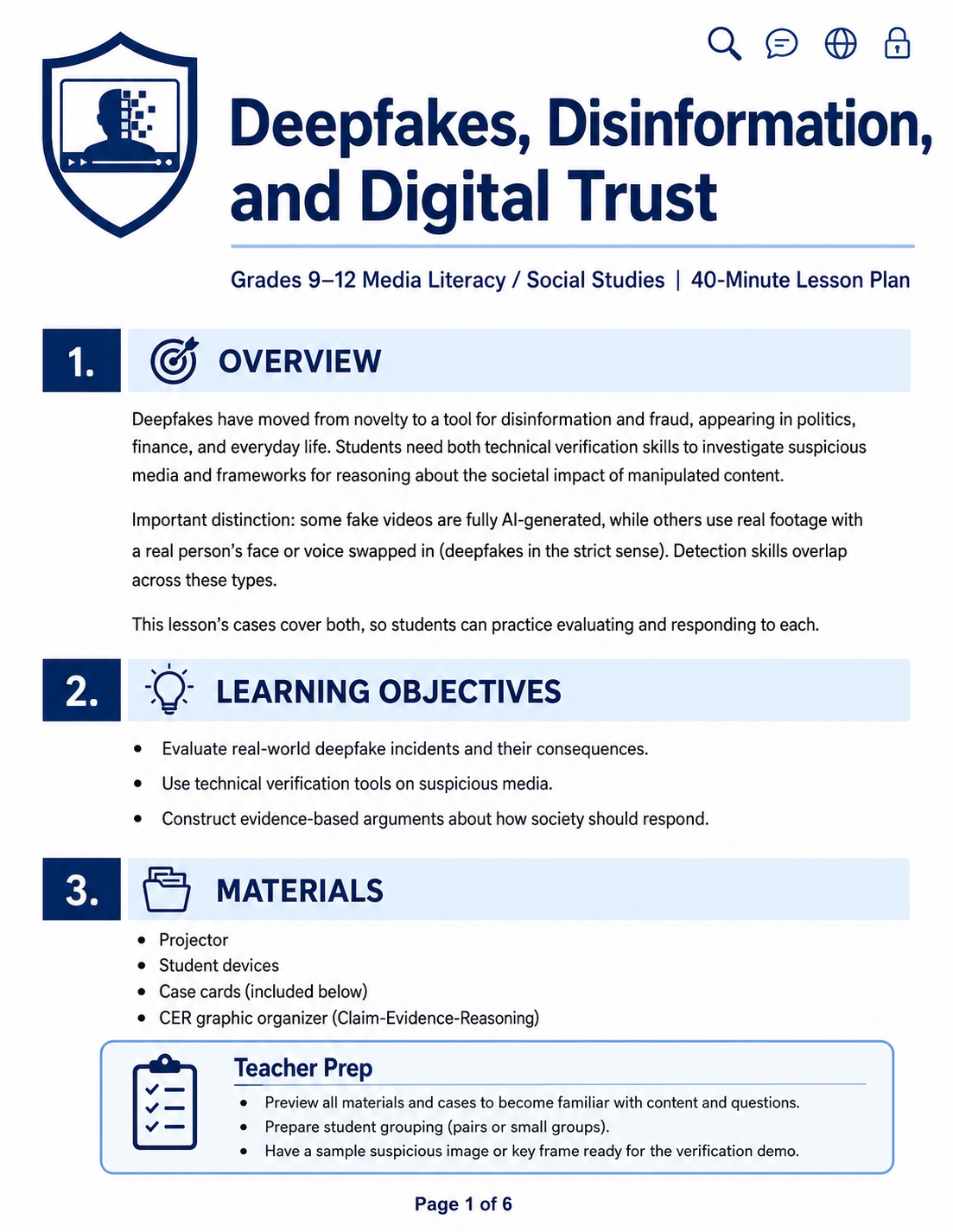
Lesson Plan B — "Deepfakes, Disinformation, and Digital Trust"
PDF · 6 pages · Grades 9-12 · 40 minutes
Confidence-gap poll hook, jigsaw discussion of 4 verified real-world case cards (elections, fraud, schools, celebrity scams), a verification workshop covering reverse search, lateral reading, and C2PA, and a structured Claim-Evidence-Reasoning debate.
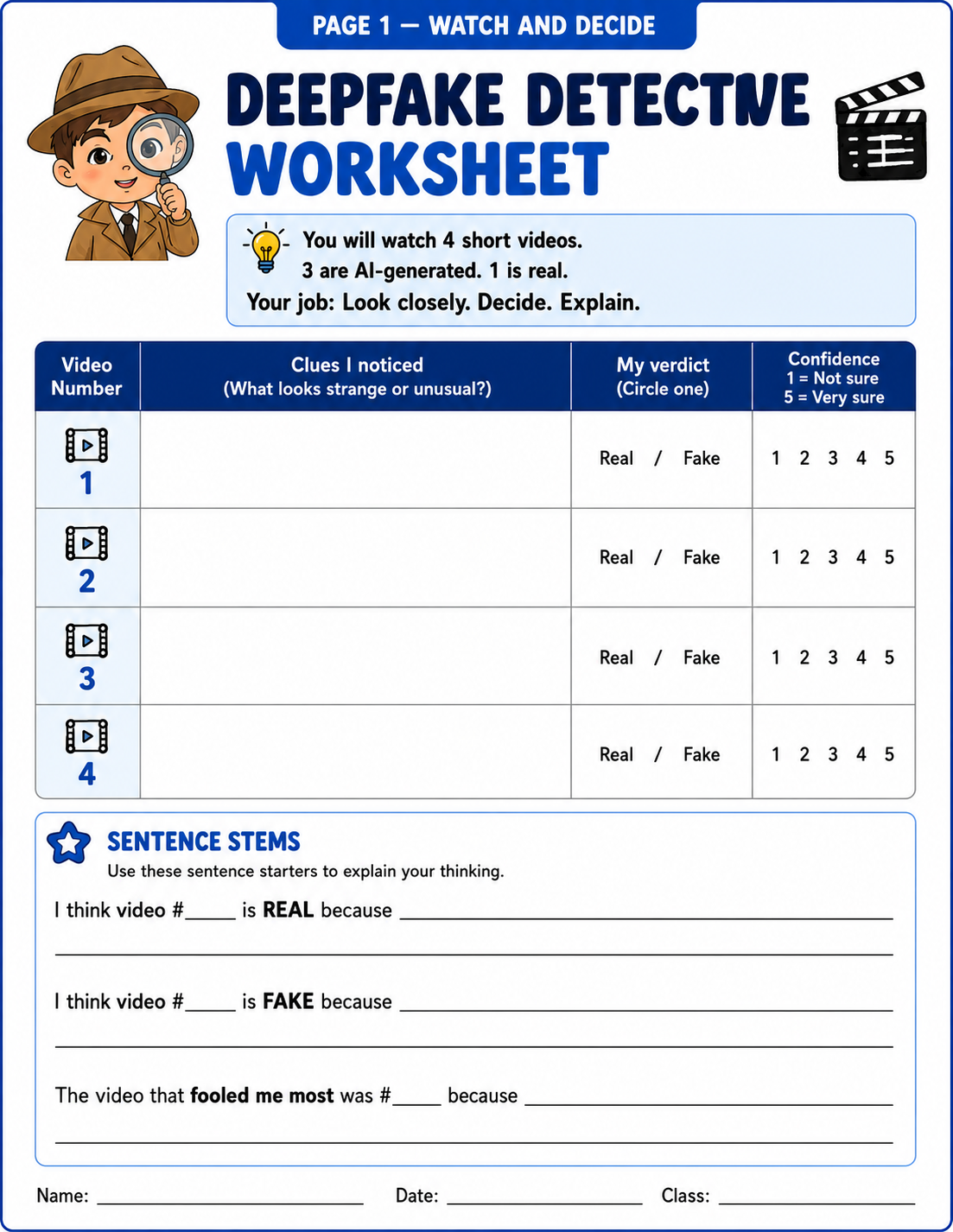
Student Worksheet — "Deepfake Detective"
PDF · 2 pages · Companion to Lesson A
Two-sided: a watch-and-decide table (clues / verdict / confidence 1-5) on the front; a Detective’s Checklist on the back that doubles as a standalone reference.
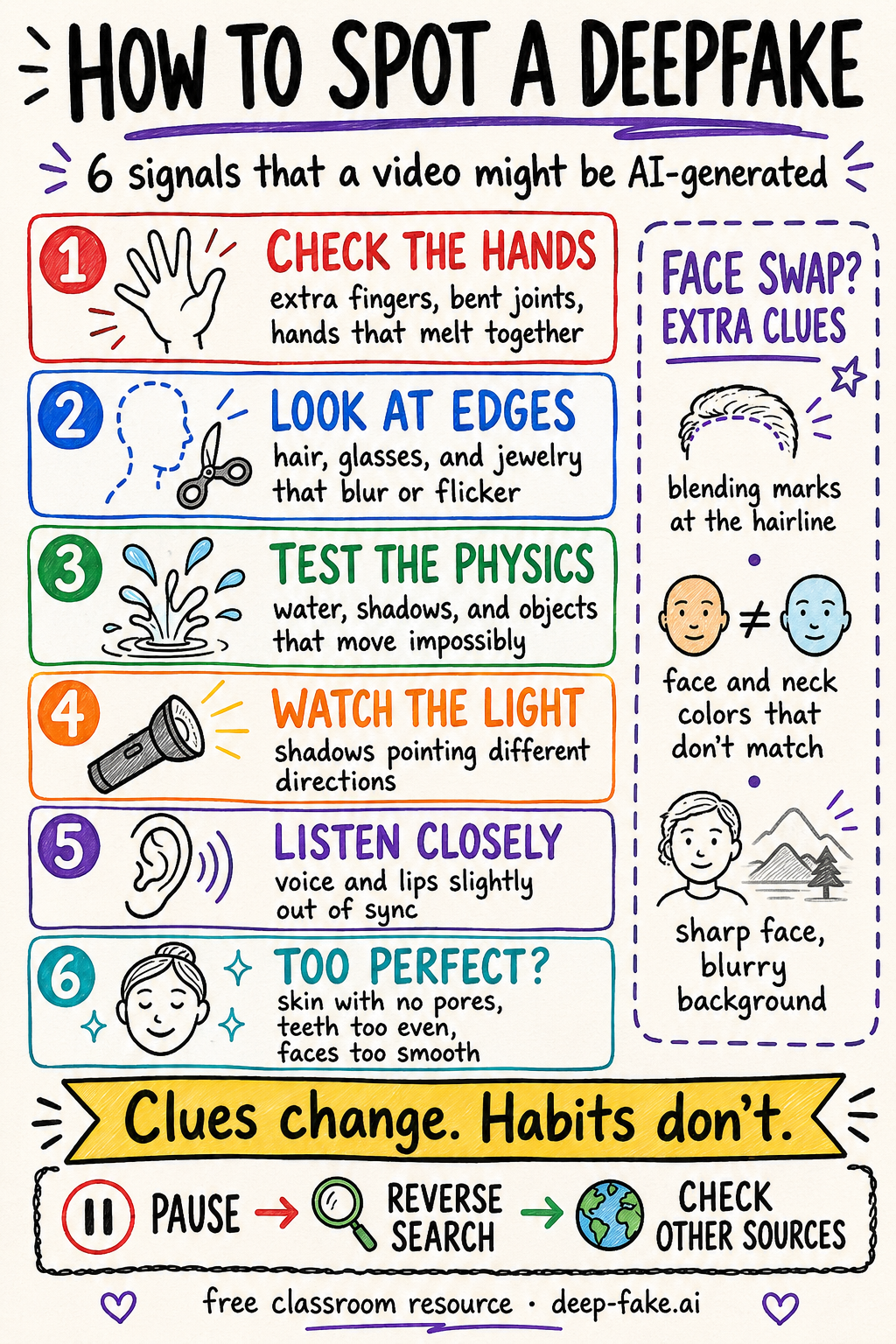
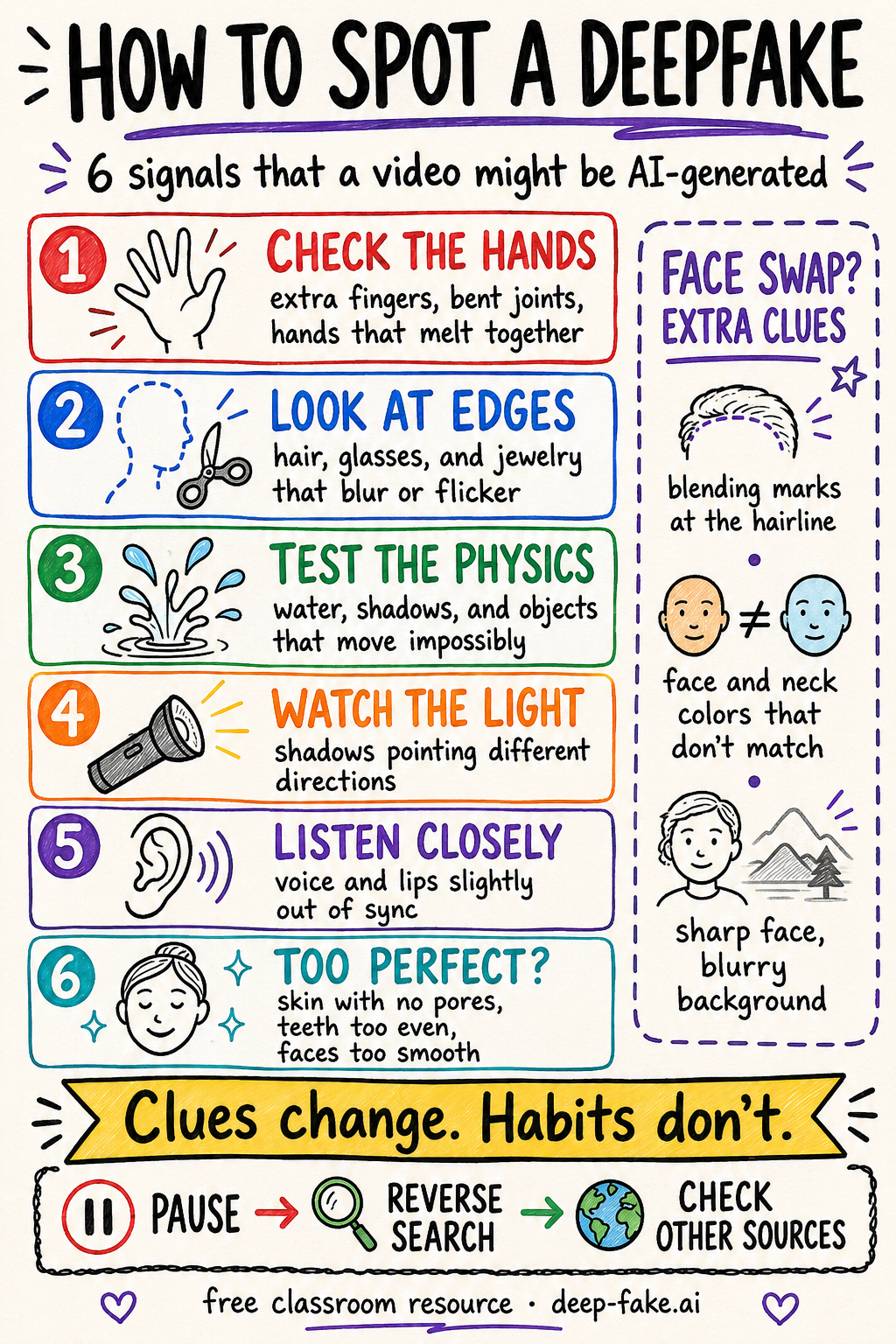
Anchor Chart — "How to Spot a Deepfake"
PDF + PNG · Poster · All grades
A hand-drawn-style classroom poster: 6 detection signals, a face-swap sidebar, and the banner "Clues change. Habits don’t." with the 3-step habit. Print at 18×24 in or A4/Letter.
Everything here may be printed, copied, and adapted freely for classroom or library use. Just credit the source if you republish. Librarians: these work as-is for morning-broadcast "real or fake" challenges and media literacy programming.
Why Teach Deepfake Literacy Now
This stopped being a future problem:
- The FBI’s Internet Crime Complaint Center (IC3) broke out AI-enabled crime as its own category for the first time in its 2025 annual report: 22,364 complaints explicitly citing AI, with $893 million in reported losses. That includes $632 million lost to AI-driven investment fraud and $352 million lost by victims over 60. Total cybercrime losses hit $20.87 billion, up 26% year over year and the highest in the report’s 25-year history (FBI IC3 2025 Annual Report).
- 62% of enterprises experienced a deepfake incident in the past 12 months (Gartner, 2025 AI Risk Management Survey).
- Industry trackers, which count incidents more broadly than the FBI’s victim-reported figures, show the same curve: Surfshark counted 179 deepfake incidents in Q1 2025 alone, already 19% more than all of 2024; Resemble AI verified 2,031 incidents in Q3 2025 alone; identity-verification firm Signicat found deepfakes grew from 0.1% to 6.5% of all fraud attempts in three years, a 2,137% increase. Deloitte projects US generative-AI fraud losses will reach $40 billion by 2027, up from $12.3 billion in 2023.
The student-side problem is quieter, and worse: they think they can tell.
A preregistered behavioral experiment (N=210) found that people cannot reliably detect deepfakes; that neither warnings nor financial incentives improve accuracy; that viewers systematically mistake fakes for real videos (the "seeing is believing" heuristic); and that participants significantly overestimate their own detection ability: the worse they perform, the more confident they are (Köbis, Doležalová & Soraperra, 2021, "Fooled twice: People cannot detect deepfakes but think they can", iScience 24(11)). Follow-up studies replicated the same confidence gap for audio deepfakes (Bray et al., PLOS ONE 2023) and even when participants were given detection strategies (Somoray & Miller, Computers in Human Behavior 2023).
Both lesson plans open on exactly this finding: poll the class with "How confident are you that you’d spot a deepfake?", then reveal the research. It lands every time.
What Still Works in 2026 — and What Doesn’t
Plenty of teaching materials still tell students to watch for unnatural blinking. That tell comes from a 2018 paper (Li, Chang & Lyu). Early training datasets were built from open-eyed photos, so early deepfakes rarely blinked. It’s obsolete. Modern models blink naturally, and some generators have been adversarially tuned against blink detection specifically. The same goes for mangled hands and flickering backgrounds: the current generation of video models routinely passes an eyeball check on the first try, and the newest models generate synchronized audio.
Here are the six signals that still hold, the ones in the lesson plans and on the anchor chart:
- Warping during camera motion. Object edges subtly distort during pans and zooms. Pause mid-move and look.
- Physics and continuity errors. Water that ignores conservation of mass, background buildings that quietly reshape between shots, clothing patterns that change frame to frame.
- Details that collapse under zoom. Fabric textures that tile strangely: normal from a distance, wrong up close.
- Missing microexpressions. The sub-100-millisecond facial muscle movements that accompany speech and emotion. Current models still can’t produce them.
- Lip-sync drift. Subtle audio-visual misalignment. The FBI lists lip-sync anomalies as a tell for deepfake job-interview fraud.
- Compression fingerprints. AI-composited regions compress differently than naturally captured footage. (In the 9-12 technical extension, not on the poster.)
Face swaps: extra clues
Some fakes aren’t generated from scratch. They’re real footage with a real person’s face swapped in (deepfakes in the strict sense). Four extra signals: blending marks near the hairline and jawline; a skin-tone break between face and neck; a face that’s unusually sharp against a blurry body or background (compute is concentrated on the face); face lighting that doesn’t match the scene. For these, reverse image search is especially effective: it often surfaces the original, un-swapped video.
And the one honest sentence every resource in this set repeats, because it’s the core teaching claim: visible artifacts disappear a few model generations at a time, and detection tools are probabilistic (roughly 80-88% accurate against the newest models, worse on heavily compressed footage). A tool result is a strong signal, not proof. That’s why verification habits beat artifact-spotting: pause (don’t share on impulse) → reverse-search a keyframe (Google Lens / TinEye) → read laterally (open a new tab and see what other sources say). The industry’s long-term answers (temporal-consistency analysis, rPPG blood-flow signals, C2PA content credentials) live in the tool layer. The habit layer belongs to your students.
One more thing teachers owe their students, said out loud: the checklist above has a shelf life. Video models now improve on a monthly cadence. ByteDance shipped Seedance 1.0 in June 2025 and Seedance 2.0 in February 2026; the newer model generates roughly 20-second clips with believable physics, currently leads blind human-preference leaderboards, and leaves few of the artifacts listed above for the naked eye to find. Detection research tells the same story: in a University of Tokyo and Max Planck Institute study, detectors built for earlier generators scored barely better than a coin toss on footage from the newest models. For now, frontier models are hard for most people to access, and their content rules restrict generating real people. Neither barrier is permanent. So the one awareness that matters more than any checklist: students should treat every image and video online as unverified until checked. Even if it looks completely real. Even if it appears to be someone they know.
The "How to Spot a Deepfake" Anchor Chart
The six signals above, condensed into a hand-drawn-style anchor chart with a title readable from the back row. The bottom banner carries the slogan of the whole set ("Clues change. Habits don’t.") plus the three-step habit: PAUSE → REVERSE SEARCH → CHECK OTHER SOURCES.
Printing notes: best at 18×24 inches in color; still crisp in black-and-white on A4 or Letter; the web version drops straight into an LMS or slide deck.
Four Real Cases for Classroom Discussion
These are the case cards from Lesson Plan B. Every fact below has been verified against primary sources; outcomes, amounts, and dates are exact, including the parts that usually get reported wrong.
Case 1 — The New Hampshire fake Biden robocall (January 2024)
Political consultant Steve Kramer commissioned an AI clone of President Biden’s voice and robocalled thousands of voters before the primary, urging Democrats not to vote. The FCC fined Kramer $6 million for caller-ID violations, and the transmitting carrier, Lingo Telecom, paid a $1 million settlement. But in June 2025, a New Hampshire jury found Kramer not guilty on all 26 criminal counts (13 felony voter-suppression charges and 13 misdemeanor impersonation charges), and as of late 2025 the FCC fine remains unpaid (NHPR; FCC 24-59).
Teaching angle: election integrity, and "the technology is new, the laws are old." The acquittal makes a far better discussion than a tidy conviction story: existing law genuinely struggles with AI cases.
Case 2 — The Arup deepfake video call, Hong Kong (January 2024)
A finance employee at the engineering firm Arup received a suspicious email about a confidential transaction, and was right to be suspicious. But on the video call that followed, every other participant, including the "CFO," was a deepfake. Faces and voices checked out, doubts dissolved, and the employee wired HK$200 million (about US$25.6 million) in 15 transfers to 5 accounts. No arrests; the funds were never recovered (CNN).
Teaching angle: the total failure of "seeing is believing": the initial suspicion was correct, and the video call is what defeated it. This is the Köbis finding with a $25.6 million price tag.
Case 3 — The Pikesville High School audio, Maryland (January 2024)
Facing a contract non-renewal, athletics director Dazhon Darien used AI to clone principal Eric Eiswert’s voice and fabricated a racist, antisemitic recording, which spread widely. The principal was suspended and received threats before investigators traced the fake. In April 2025, Darien entered an Alford plea to disrupting school operations and was sentenced to four months; the principal later settled a lawsuit with the school system (NBC News; Baltimore Banner).
Teaching angle: audio deepfakes harm ordinary people, not just celebrities. The victim’s perspective matters most.
Case 4 — Fake celebrity and doctor endorsements (ongoing)
AI-generated videos of celebrities and physicians push fake investments, miracle cures, and giveaway scams across social platforms. The scale is what the FBI’s numbers above measure: 22,364 AI-citing fraud complaints and $893 million in losses in 2025 alone.
Teaching angle: financial self-defense, and why platforms can’t keep up.
In Lesson Plan B, each card comes with three analysis questions (Who was harmed? What made it believable? What could have exposed it?) and a facilitator note. Jigsaw groups, 15 minutes.
Built Like Real Lesson Plans, Not Blog Posts
Both plans follow the format your department head expects:
- Minute-by-minute 40-minute flow: hook (5) → mini-lesson (8) → core activity (15) → verification practice (7) → exit ticket (5), with Lesson B structured around the case jigsaw and CER debate.
- Sentence stems and a CER organizer. Grades 6-8 argue from "I think video #___ is real/fake because ___." Grades 9-12 run a Claim-Evidence-Reasoning debate on "Should platforms be legally required to label AI-generated media?"
- Differentiation: supports for struggling learners, extensions for advanced students.
- Sensitive-content advisories. Preview every clip. For grades 6-8, keep examples low-stakes and fun (animals, sports). Never show students harmful, sexual, violent, or political deepfake content.
- Standards alignment for digital literacy, ELA, and social studies filing: CCSS.ELA-Literacy CCRA.R.1, R.7, SL.1, W.1; NGSS SEP.7 (engaging in argument from evidence); ISTE Digital Citizen (1.2) and Knowledge Constructor (1.3).
FAQ
How do deepfakes work?
In the strict sense, a deepfake impersonates a real person: face swapping, voice cloning, or lip-syncing, powered by deep learning models trained on footage of the target. Since 2024, though, the boundary has mostly dissolved. The mainstream way to make a deepfake today is to feed a real person’s photo into a general video model’s image-to-video or character-consistency feature. These resources cover both: the detection skills (generation artifacts, audio-visual drift, verification habits) transfer across both types, and face swaps get four extra dedicated clues.
Are these really free? What’s the catch?
Free, no sign-up, no email. Print, copy, and adapt them for any classroom or library use; credit the source if you republish them publicly.
Can I use this with K-5?
The plans are designed for grades 6-8 and 9-12. For K-5, keep it foundational: "not everything online is real," plus the anchor chart’s habit reduced to pause, then ask a trusted adult. We don’t recommend showing deepfake examples to younger students.
Where do I find video clips for the activity?
Lesson Plan A includes a where-to-find-clips box: source AI clips from the official showcase channels of major video models (Veo, Kling, and Seedance showcases on YouTube), and real clips from nature documentaries or verified news outlets’ animal and sports footage. Play them as screen recordings so titles and comments don’t spoil the answers, and verify the provenance of your "real" clip yourself.
Is there a detection tool I can just use?
There are several (reverse image search with Google Lens or TinEye, video analysis with InVID, and content credentials via C2PA), and Lesson Plan B’s verification workshop teaches them. But be straight with students: detection tools are probabilistic, and a result is a strong signal, not proof. That’s exactly why this unit teaches verification habits rather than a magic detector.